You are browsing the archive for: April 2007
27 April 2007

Incoming

Anne’s crisp voice came through loud and clear on my headset as the English coast retreated behind us.

“Does anyone want a biscuit?”

Cliff responded for the both of us. “Not now, Mum. It’s only a short flight.” He shook the map at her, as if she could see it from the rear seat.

I flew straight across the Channel, above the tiny boats motionless on frozen white crests of waves. We’d only been in the air for half an hour when I held up my hand for quiet as I requested clearance to enter restricted airspace. I was told to proceed to the Casquets.

“Or some cheese? I have cheese too.”

Born in 1924, Anne doesn’t suffer from the traditional war-child malaise of worrying where her next meal might come from. She carries it in her handbag.

I gave her a vague wave. I didn’t have time for nibbling. I needed to find the Casquets. My sigh of relief was audible in the cockpit when the three towers perched upon straggly rocks came into view. I slowed right down and wished for my camera.

Just as we were enjoying the birds’ eye perspective of the lighthouse clinging to the sandstone reef, the next call came in: report Guernsey in sight.

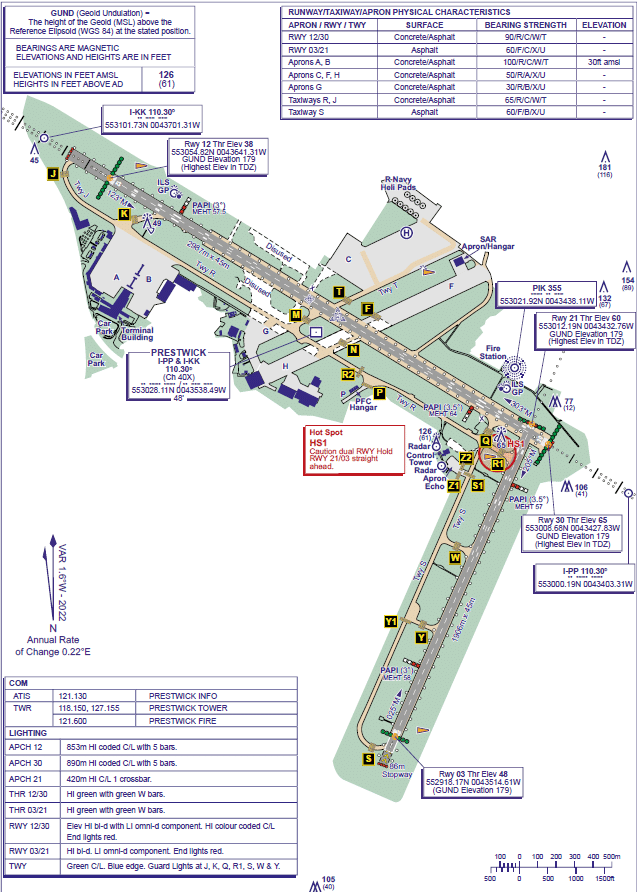
I panicked. We were still 15 miles away from the coast. There was a haze of grey land in front of me but did they really believe I could see the runway from this distance?

“I’ve got a bit of chocolate as well,” Anne continued. “As we didn’t have time for breakfast.”

The runway is 1500 metres long, how hard could it be to find? I rubbed my eyes and stared at the rapidly approaching island, then down at the map and back at the island. I couldn’t see it.

The radio hissed into life.

“November Echo X-ray, do you have it in sight?”
“I have the island in sight but not the runway.” I look down, as if to confirm.

As I did, I realise, cheeks aglow, that he had meant the island from the start, not the runway. There was a pause before he responded, politely refraining from laughing while the microphone was on.

“November Echo Xray, we are at your two o’clock. Report airfield in sight.”

I looked to my right, convinced that I was about to run out of island and head straight into France, when I saw it: a beautiful long strip of grey perfectly positioned for me to do a gentle turn towards it and land.

We had arrived. My passengers seemed a lot less surprised by this than I was.

20 April 2007

Geoffrey’s Leap

Driving along a coastal road, I saw something at the last moment.

“Stop the car! There was a sign back there.”

Cliff slammed on the brakes. “A sign for what?”

“I dunno, but it looked interesting.”

He gave me a nasty look but backed the car up and found a wide bit of road to pull over on. We hiked back to look at the sign, a chunky bit of stone with “National Trust for Jersey – Le Saut Geffroy” written on it.

“What’s it mean?”

Cliff shrugged. “I don’t speak patois. Something to do with Geoffrey. Jump, maybe.”

Jump seemed viable, it was a ledge looking over rocky outcrops in the sea. I thought it quite a nice spot to sit and watch the birds until I heard the story behind it.

It seems poor Geoffrey had been sentenced to death, and specifically to be pushed off this ledge. A crowd had gathered to watch his demise but to everyone’s surprise he landed in the water and swum to shore, safe and sound. He climbed back up to the ledge where an argument had broken out as to what should happen next: should he be pushed off again or should he walk free, having already “received” his punishment. He laughed at the crowd and jumped off the ledge with a smile – this time missing the water and dashing his brains out on the rocks. The dilemma was solved, and the ledge named after his fateful move (generally translated as Geoffrey’s Leap).

Luckily, I knew none of this as I sat watching the oystercatchers on the rocks below me.

12 April 2007

Chapelle-ès-Pêcheurs

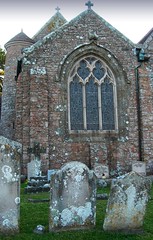
The Parish Church of St Brelade is a romantic Norman stone structure, dating from the 11th century, a reminder of French government of Jersey. I paused to look at the stained glass windows but I was much more interested in its neighbour, The Fisherman’s Chapel.

The Fisherman’s Chapel is a chantry, a medieval pay-for-prayer chapel endowed by the rich to ensure that prayers would be said for their souls after their death. This one is a squat square building, high on a ledge, looking out over St Brelade’s Bay. The location probably led to the theory that the name, Chapelle-ès-Pêcheurs, was to do with the Fisherman’s Guild but this has fairly recently been rescinded. It’s currently believed that the name comes from a corruption of sinners in French: pécheurs.

I have sympathy for this more recent view, I am not very good with orthographics either.

The story goes that the chapel was meant to be built much further inland at a spot better protected from the wind and the sea but, unknown to the builders, the chosen spot was already inhabited by les p’tits faîtchieaux, the fairies. In the night, they quietly picked up all the tools and materials and left them by the shore. The next day, the workers retrieved their items and began work on the foundations. Of course, the little people undid all the work and moved everything back down to the shoreline again in the night. The people took the hint and built the chapel where the tools had been dumped: at the shore of St Brelade’s Bay.

The actual reason for the location is no less interesting: the chapel was built to replace a previous chapel: a simple one-room wooden cell that, according to ancient folklore, was built by Brelade himself. It is quite probable that Brelade travelled to Jersey in the 5th century: he was known to have been on Guernsey and was travelling all over to found religious communities. The exposed location and view of the bay as well as the circular churchyard are all typical of the Celtic religious communities of that time. Certainly there is evidence of a structure from the middle of the 6th century, so the legend isn’t far off.

The current stone structure was built in the late 1000s at the time of the construction of the main chapel. It is quite literally made of the sea, “limpet shells crushed and dissolved with boiling sea water” formed the mortar for the building.

It wasn’t until 1918 that the medieval frescoes were discovered preserved under a layer of plaster: it was these that I came to see. They are incredibly well preserved, angels and disciples in medieval dress portraying the Annunciation and the Assumption. I was thrilled to see that the paintings had not been fully restored but instead reproductions of what they would have looked like at the time are displayed on plastic coated story boards left near the entrance for you to compare to the work on the walls.

We left to amble down the path leading to the perquage, the safe-passage which exists in every parish, the extension of the church sanctuary leading down to the sea where the criminal could board a boat. All around us are the lichen covered gravestones, worn down from the constant salty wind from the exposed position of the graveyard. One large rose-coloured stone in pristine condition caught my eye. It chronicled a family called Davis, starting with a woman born in Jersey in 1866 who died (last, in 1954) in London, her brother and his wife who died in South Africa during the Second World War, their son who was killed in 1916 at the Battle of the Somme in France, and ends with the “two kind and lovable ladies who died at Port Elizabeth South Africa in January 1951″.