You are browsing the archive for: September 2011
30 September 2011

PULL UP PULL UP: Garuda Indonesia flight GA200 in Yogyakarta

I’ve been reading an old accident investigation report from the National Transportation Safety Committee in Indonesia. You may recall the frightening photographs that hit the press in March 2007, when this Boeing 737 overran the runway at Yogyakarta and was destroyed from the impact and resulting fire. One flight attendant and twenty passengers were killed and twelve others were seriously injured.

Dozens of passengers leapt from the national carrier Garuda Airline plane's emergency exits into surrounding rice paddy fields to escape the inferno, which reduced the aircraft to a smoldering wreck of twisted metal. -Dwi Prasetyo on Reuters.com

The accident investigation report reference KNKT/07.06/07.02.35 is available online at the NTSC site as a PDF: Final Report.

Here’s my summary and analysis of the key information including excerpts from the Aircraft Accident Investigation Report by the NTSC. All images are from the report unless otherwise noted, in which case they link to the original source.

All times are given in UTC. Local time for Yogyakarta, Indonesia is UTC+7 hours.

On 7 March 2007, a Boeing Company 737-497 aircraft, registered PK-GZC, was being operated by Garuda Indonesia on an instrument flight rules (IFR), scheduled passenger service, as flight number GA200 from Soekarno-Hatta Airport, Jakarta to Adi Sucipto Airport, Yogyakarta. There were two pilots, five flight attendants, and 133 passengers on board.

ATC referred to the flight as “Indonesia 200″.

Here’s the timeline of the events:

21:30 Pilot in Command (PIC) and co-pilot commence duty at Jakarta.

Both pilots had over a day of rest time before the flight. There’s no evidence that either was unfit for duty.

The PIC had logged 13,421 hours flight time with 3,703 as pilot in command on type. He completed Controlled Flight into Terrain and Approach-and-Landing Reduction training recurrency just over a year before the accident.

The copilot had logged 1,528 hours of which 1,353 were on type.

Both crew members had attended an introductory seminar for the Enhanced Ground Proximity Warning System in 2005.

However, the accident report notes that there is no evidence that either pilot had been checked or received Boeing 373 similator training for appropriate vital actions and responses for alerts as warnings, such as TOO LOW TERRAIN and WHOOP, WHOOP, PULL UP. Note that the correct response to such a warning is to take control of the aircraft and aggressively apply maximum thrust, get the wings level and pitch up to 20 degrees. This will be important later.

23:17 Indonesia 200 departs Jakarta.

PIC was the pilot flying with the copilot offering monitoring and support. The initial flight was uneventful.

Up to the time of the top of descent briefing, the oral communication between the PIC and the copilot, air traffic control approach and tower controllers, and the company radio, were in normal tones and in an orderly manner. Subsequently, during the approach below 10,000 feet and prior to reaching 4,000 feet, the PIC was singing and there was some minor non-essential conversation, which was not in accordance with the Garuda Basic Operations Manual policy for a sterile cockpit below 10,000 feet.

23:43 PIC begins the crew briefing. The briefing is interrupted by Yogya Approach with clearance. After the radio call, the PIC continued with the crew briefing for an ILS approach.

23:54:10 Pressure altitude 6,560 feet, airspeed 269 knots
Yogya Approach asks the crew to confirm that they are visual.
The copilot responds with ‘affirm’.

At no time did the copilot inform ATC that they were flying the 09 ILS approach.

The Approach Controller cleared Indonesia 200 “for visual approach runway zero nine, proceed to long final, report runway in sight.”

The copilot read back the clearance and asked if they were cleared to descend to circuit altitude.

23:54:33 Pressure altitude 5,792 feet, airspeed 279 knots
The Approach controller clears Indonesia 200 to descend to 2,500 feet.

During this descent the PIC commented “Oops, strong wind”, showing a lack of observation of the strong wind they’d encountered during the flight. The wind at this stage had decreased from previous levels as they descended.

Eleven seconds after expressing concern about the wind, the PIC said ‘Target enam koma enam ILS, kagak dapat dong’ (the target is 6 point 6 ILS, we will not reach it). The PIC then attempted to trade off excess airspeed and lose height, but only succeeded in flying a flight path that was erratic in pitch, causing the airspeed and altitude to vary considerably. The PIC flew an unstabilized approach.

23:55:19 Pressure altitude 4,384 feet, airspeed 293 knots
The aircraft at this stage is at 3,419 feet above aerodrome elevation and flying much too fast.

The Garuda Aircraft Operation’s Manual specifies a maximum control speed in the terminal area below 10,000 feet as 250 knots. A speed over 250 knots requires air traffic control approval.

The airspeed increased from 288 knots to 293 knots then reduced to 243 knots.

Effectively, the PIC went into a steep descent to trade height for speed at a point in the approach when he should be losing height and speed. He lost 2,912 feet with his erratic flight path.

23:55:33 Aircraft is 10 miles out. Initial fix in the approach chart is 2,500. Aircraft was 1,427 feet above this and travelling at 283 knots.

The company Operations Manual required the aircraft to be configured for the landing, with the landing gear extended, flaps 15, and the airspeed 150 knots, when approaching the final approach point (FAP), one dot up on the glideslope instrument. When GA200 passed the FAP, the speed was 254 knots (groundspeed 286 knots), and it was in the clean configuration, meaning that the landing gear and flaps were not extended.

This is twenty seconds after he’d stated that they won’t reach the target.

23:56:35 Pressure altitude 3,456 feet, airspeed 239.5 knots
Wing flaps 1 degree position set.
Yogyakarta Tower: Surface wind calm, continue approach runway 09 report final

Runway 09 has a landing distance of 2,200 metres.

23:56:46 Pressure altitude 3,296 feet, speed 231 knots
PIC: gear down

They are now 2,596 feet above aerodrome elevation.

The gears are extended. The plane continues to descend. It is too high and too fast.

23:56:49 PIC: oh there is something not right

Between 23:56:49 and 23:57:20 the aircraft was in an unstabilized approach condition with the speed varying between 229 and 244 knots, pitch varying between 3.5 degrees up and 3.8 degrees down, and the rate of descent reached 3,520 feet per minute at 23:57:20.

[...]

The PIC said ‘The target is 6.6 ILS, we will not reach it’. The PIC flew an unstabilized approach. He also realized the abnormal situation when he commented ‘Wah, nggak beres nih!’ (‘Oh, there is something not right’). So, the PIC’s intention to continue to land the aircraft, from an excessively high and fast approach, was a sign that his attention was channelized during a stressful time.

23:57:13 PIC: check speed, flaps fifteen

23:57:15 Ground Proximity Warning System: SINK RATE SINK RATE
The terrain closure rate is 3,461 feet per minute. The aircraft is 1,369 feet above the runway.

23:57:17 Copilot: flaps five

The PIC requested fifteen as well as a speed check. The copilot did not offer a speed check nor did he make any attempt to explain why he intended to set the flaps to five instead of fifteen.

The reason was clear. The recorded airspeed of the aircraft at that point was was 238 knots. The maximum indicated airspeed for extension of flaps to the 15 position is 205 knots. So why didn’t he say so?

At interview the copilot stated that he did not extend the flaps to 15 degrees as instructed by the PIC, because the airspeed exceeded the maximum operating speed for flaps 15.

The PIC stated that he was unaware of the actual airspeed, and expected that the copilot would inform him of any speed concerns.

Quite right! On the other hand, he’s already ignored the Ground Proximity Warning System and he did not react to any of the other statements by the co-pilot, so it may not have made a difference. Still, there’s a critical failure here in terms of monitoring and support.

23:57:19 Tower Controller: Indonesia 200, wind calm, check gear down and lock clear to land runway 09
Ground Proximity Warning System: TOO LOW TERRAIN TOO LOW TERRAIN

23:57:23 The copilot selects wing flaps to the five degree position.
PIC: Clear to land Indonesia 200

Remember that as far as the tower controller is aware, they are doing a visual approach.

23:57:29 PIC: Check speed, flaps fifteen
PIC: Flaps fifteen
PIC: Flap fifteen
PIC: Check speed, flap fifteen

Their speed was around 252 knots at the first of these four times the PIC requested flaps fifteen. Maximum flaps operating speed for Flaps 5 is 250 knots. Flaps 15 maximum is 205 knots.

During this time, and until 1 second before the GPWS sounded ‘ten’, meaning 10 feet above the runway, the GPWS warning continued to sound loudly.

At interview, the PIC stated that he continued to call for flap fifteen because he was committed to land from the approach, and was aware that he would not be able to use flaps 40 as planned. He knew the risks, but believed that he could safely land using flaps 15, even with the higher airspeed required for a flap 15 approach.

23:57:34 Flaps reach the five degrees position
The aircraft is 569 feet above the runway. Airspeed is 254 knots, rate of descent is 1,600 feet per minute.

Garuda Indonesia Operations Manual states that any approach that becomes unstabilised below 500 feet above the aerodrome in VMC requires an immediate go around. The aircraft had never achieved a stabilised approach.

23:57:37 PIC: flight attendant, landing position

This was seventeen seconds before touchdown. The flight attendants should have been given enough time to sit and fasten their seat belts and “sit quietly for one minute to recall the emergency memory items.”

23:57:41 Ground Proximity Warning System: WHOOP, WHOOP, PULL UP

You’ll remember the correct response to this warning is to aggressively apply maximum thrust. That is, go around.

23:57:43 Copilot: Wah Captain, go around Captain

The aircraft is 217 feet above the runway. I don’t know about you but I was shouting “Go around!” at my screen long before this point.

23:57:45 Ground Proximity Warning System: WHOOP, WHOOP, PULL UP

There’s no justifiable reason not to go around at this point. This is pretty much the definition of an unstabilised approach. Almost every factor is wrong.

The copilot should have taken control and initiated a go around as the PIC hadn’t.

The PIC response to the situation is telling.

23:57:47 PIC: Landing checklist completed, right?

The PIC does not appear to have registered the warnings nor the copilot’s call to go around at all. The accident report describes his actions as fixated.

He intended to land the aircraft, so that the other tasks and warnings (GPWS ‘PULL UP’ and calls from the copilot) were either not heard or were disregarded. His attention was channelized and focused on landing the aircraft from the approach.

That is to say, his every priority was the landing and he simply disregarded all information that was not directly relevant to landing the plane. He never considered aborting the landing, so information relevant to not landing the plane was disregarded.

The copilot made no attempt to take control of the aircraft from the PIC.

Seven seconds before touchdown, the rate of descent was 1,400 feet per minute and decreasing. The aircraft crossed the runway 09 threshold at 89 feet above the ground (704 feet pressure altitude), at an airspeed of 234 knots (groundspeed of 236 knots).

The aircraft is travelling 98 knots too fast as it crosses the threshold.

The aircraft levelled off about ten feet above the runway for 4 seconds before touching down with a groundspeed of 235 knots.

The touchdown should have occurred around 300 metres from the landing threshold. The touchdown zone ends at 620 metres.

23:57:54 The aircraft touches down for the first time, 860 metres from the threshold, airspeed 221 knots.

The landing speed for 40 degrees flap is 134 knots. The maximum tyre speed is 195 knots groundspeed.

The plane’s touchdown speed was 221 knots. It landed 240 metres past the touchdown zone.

23:57:54 Copilot: go around

The aircraft bounces. Twice.

At the third (final) touchdown, the nose landing gear touches down heavily before the main landing gear.

The g force at the third (final) touchdown was about 2.9 g, and the aircraft’s pitch angle was about -1 degree (nose down), which caused the nose landing gear to touchdown heavily before the main landing gear. The left nose wheel tire failed due to high rotational forces applied during the initial landing roll. The subsequent bending load on the left nose wheel axle was above the material’s ultimate strength and caused the left axle to fail. Metal from the failed left nose wheel slashed the right nose wheel tire, causing deep cuts to the tire’s crown. The outer hub of the right nose wheel separated, leaving pieces on the runway. The inboard hub of the right nose wheel remained attached to the right axle and was scoring the runway during the high speed landing roll.

I have to give the PIC credit, that’s perfectly lined up on the centre-line, even after two bounces!

23:58:10 The aircraft overran the departure end of runway 09 at Yogyakarta Airport.

The Runway End Safety Area (RESA) is a paved area of 60 metres long. There is an additional 98 metres of grass thereafter which is not defined as part of the RESA. The ICAO standard requires a distance of at least 90 metres and recommends a RESA of 240 metres or more for a Category 3 airport such as Yogyakarta.

The PIC reported that as the aircraft was about to leave the runway, he shut down both engines. The aircraft crossed a road, and impacted an embankment before stopping in a rice paddy field 252 meters from the threshold of runway 27 (departure end of runway 09).

The fire fighting personnel noted the fast and high approach of the aircraft and the burst wheel on the runway. They mobilised two fire fighting vehicles to the perimeter fence immediately. But they couldn’t get past the embankment that the aircraft had barrelled through.

The fire fighters were unable to reach the wreckage due to the embankment and remained in position about 130 metres from the centre of the crash site. They sprayed the foam fire suppressant from the embankment but it was too far for the spray gun to reach. They attempted to deploy the flexible hose but it was punctured by vehicles driving over it and on the airport fencing. As a result of the lack of pressure, they were not able to cover the whole surface of the wreckage.

The fire was uncontrolled and consumed the aircraft.

The Airport Emergency Plan (AEP) required, the chief of fire fighting AP1 to lead the fire fighting operation, but at the time of the accident he was not able to lead the operation, due to too many people trying to act as leader and giving commands to fire fighting personnel. About 45 minutes after the accident, two city fire fighting vehicles arrived and were ordered by an un-qualified person to start hosing the fire. However, the city vehicles did not have foam; only water.

02:10 The fire is finally extinguished. The rescue operation continues.

Human factors are always an issue in any emergency situation and must be taken into account. But this Garuda Indonesia accident was so beset by problems, it is off the charts.

The co-pilot appears to have completely failed to offer basic monitoring and support to the pilot. He did not appear to notice the wind, he did not warn the PIC of excessive speed, he chose not to fulfil the PIC’s instructions but did not tell the PIC, and he did not respond at all to the repeated requests for a speed check. Once it was clear that the PIC planned to continue the landing from an unstabilised approach, he should have taken control of the aircraft and gone around.

The chaos of the rescue operations encompasses a further few pages of the report, which I have not covered in detail here. It took over two hours to extinguish the fire and although the report is not clear on the effects of this, it does say that this delay “may have significantly reduced survivability”.

But all of this pales into insignificance in the face of the pilot who continued the approach and landing despite all evidence available to him that this was an unsafe landing.

Garuda Indonesia’s policy is very clear: in case of an unstabilised approach, go around. Let’s see how many of the elements of a stabilised approach were in place?

Garuda Stabilised Approach Procedure
Recommended Elements of a Stabilized Approach
All approaches should be stabilized by 1000 feet HAA in instrument meteorological condition (IMC) and by 500 feet HAA in visual meteorological conditions (VMC). An approach is considered stabilized when all of the following criteria are met:

  • the aircraft is on the correct flight path.
  • only small changes in heading/pitch are required to maintain the correct flight path.
  • the aircraft speed is not more than VREF +20 knots indicated airspeed and not less than VREF.
  • the aircraft is in the correct landing configuration.
  • sink rate is no greater than 1,000 fpm; if an approach require a sink rate greater than 1,000 fpm, a special briefing should be conducted.
  • power setting is appropriate for the aircraft configuration.
  • all briefing and checklist have been conducted.

These conditions should be maintained throughout the rest of the approach
for it to be considered a stabilized approach. If the above criteria cannot be
established and maintained at and below 500 HAA, initiate a go-around.

The PIC did not reduce the aircraft’s speed to the target airspeed of 141 knots for the approach. The actual speed was 245 knots. The aircraft was not in the landing configuration, and the actual sink rate of 3,520 fpm exceeded the Operations Manual requirement of not greater than 1,000 fpm. The landing checklist was not completed.

In fact, I’d say that out of the seven criteria, the approach might have fulfilled one: I presume the power setting was appropriate.

As the aircraft crosses the runway threshold it should be:

  • Stabilized on target airspeed to within +10 knots until arresting the rate of flare.
  • On a stabilized flight path using normal maneuvering.
  • Positioned to make a normal landing in the touchdown zone (i.e., first 3,000 feet or first third of the runway, whichever is the less).

Initiate a go-around if the above criteria cannot be maintained.

Not any of these were in place.

The investigators asked the PIC what happened.

During interview he said to investigator that ‘his goal was to reach the runway and to avoid severe damage’. He ‘heard, but did not listen to the other voice (GPWS), and flaps 15 and speed 205 was enough to land’. The PIC experienced a heightened sense of urgency, and was motivated to escape from what he perceived to be a looming catastrophe, being too high to reach the runway (09 threshold). He fixated on an escape route, ‘which seem most obvious’, aiming to get the aircraft on the ground by making a steep descent. His decision was flawed, and in choosing the landing option rather than the go around, fixated on a dangerous option.

The NTSC Aircraft Accident Investigation Report concludes with the following primary causes:

  1. Flight crew communication and coordination was less than effective after the aircraft passed 2,336 feet on descent after flap 1 was selected. Therefore the safety of the flight was compromized.
  2. The PIC flew the aircraft at an excessively high airspeed and steep descent during the approach. The crew did not abort the approach when stabilized approach criteria were not met.
  3. The pilot in command did not act on the 15 GPWS alerts and warnings, and the two calls from the copilot to go around.
  4. The copilot did not follow company instructions and take control of the aircraft from the pilot in command when he saw that the pilot in command repeatedly ignored warnings to go around.
  5. Garuda did not provide simulator training for its Boeing 737 flight crews covering vital actions and required responses to GPWS and EGPWS alerts and warnings such as ‘TOO LOW TERRAIN’ and ‘WHOOP, WHOOP PULL UP’.

For full details, read the final report from the NTSC.


If you found this post interesting you might enjoy the following:

23 September 2011

History of Commercial Flight

Today, I was going to write an involved analysis of an accident report that I’ve been reading this week.

Then, someone who was once considered a friend sent me this link: List of firsts in aviation – Wikipedia, the free encyclopedia

and the next thing I knew, the day had disappeared. Thanks a lot!

Seriously, this is just a Wikipedia list but it is a great read. The Forerunners all sound like fascinating people and when you get to Heavier than Air, it’s amazing to see how quickly things happened.

Some early highlights:

  • First flight in a powered airplane: Gustave Whitehead, August 14, 1901
  • First take-off by an airplane from a moving ship: Commander Charles R. Samson in Short Improved S.27 No. 38 from a temporary platform aboard battleship HMS Hibernia, May 1912
  • First pilot to fly a loop: Pyotr Nesterov in a Nieuport IV, September 9, 1913
  • First dogfight: Dean Ivan Lamb, flying a Curtiss Pusher vs Phil Rader in a Christopherson biplane during the Siege of Naco, Mexico, November 30, 1913
  • First non-stop trans-Atlantic flight: Alcock and Brown — St. John’s, Newfoundland to a bog near Clifden, Ireland, June 14-15, 1919

A real breakthrough for aircraft was finding a practical application for the average person: commercial flights for convenience.

The first scheduled airline flight took place in 1914. American pilot Tony Jannus ferried one passenger at a time across the Tampa Bay in Florida. The fare was five dollars and it was the first time that people could take advantage of point-to-point scheduled flights.

I also received this lovely graphic of the history of commercial flight which Holiday Extras have been kind enough to allow me to reproduce:


That first little plane on the left is the Benoist that Tony Jannus used to ferry people across the bay. The big beast on the right is the Airbus 380 which entered commercial service in 2007. Scanning the increases in size and fuel requirements and especially the range over that span of time is just fascinating.

Next week I’ll have that accident report finished, I promise.

16 September 2011

Tipsy Nipper Crash Video

A few years back I wrote about this Tipsy Nipper going into a flat spin. I didn’t realise it at the time but a few months after my post, the pilot posted his video of the spin to YouTube with commentary. You have to watch this!

The spin was supposed to be a normal erect spin to the right, but for various unintentional reasons the spin went flat, up until that point I had never flat spun an aircraft. I eventualy mananged to get the aircraft into a normal erect spin from which I was able to recover. This aircraft is not fitted with an electric starter motor, so I was unable to restart the engine.

During the “flare” to land the main undercarriage caught the top wires of a barbed wire fence that was invisible to me.

After coming to rest inverted I waited 20mins for the rescue services to come and right the aircraft so I was able to exit via the outward opening canopy.

The aircraft rotated 26 times total, I was extremely disorientated after the recovery to straight and level flight, and was unable to read the instruments.

From the video I estimate I recovered at about 700ft from an entry altitude of 3500ft. If you listen carefully you will hear me say:”I think this is it”. At that stage I did not think I would be able to recover. However I continued to try various control inputs based on the aircraft attitude and rotational rate, which eventually effected a recovery.

My thanks go to the emergency services that found me and allowed my escape.

Here’s my original post from the time:

Fear of Landing » Tipsy Nipper feeling Dippy

Ever wondered what you’d do if you entered an unintentional spin? What about a flat spin, where the plane is horizontal and spinning like a top, all the while falling out of the sky.

Last autumn, there was a post to the Tipsy Nipper Owner’s Group Forum with this photograph and the following comment.

Whilst walking in the RSPB nature reserve in Tollesbury Essex I came across this Nipper after it had crash landed on Monday evening.

They were in the process of removing it on Tuesday morning when I went past, the pilot had a lucky escape as it had flipped over in the marsh, the pilot had to be freed by emergency crews.

The plane was immediately recognised as belonging to Neil Spooner but local news confirmed that he was unharmed. He posted on the message board within the week to let the members know what had happened:

A rather disturbing occurance, normal spin entry and the spin went flat. Having never done any flat spin training was rather at a loss as to what to do to recover (normal spin recovery techniques don’t work in a flat spin). However, a quick review of spin aerodynamics on the way down gave me a few ideas, one of which obviously worked. The engine stopped during the spin (22 rotations) which meant an outfield landing in a rather inhospitable area. The main wheels caught the two top wires of a barbed wire fence in the flare which both decelerated the aircraft and flipped it on its back. I spent 20mins waiting for the emergency services to turn up (pretty good I think) The police air support heli’ landed close by and 2 crew lifted the tail so I could open the canopy and step out. Absolutely no injuries except my pride.

Twenty-two rotations! No, he wasn’t counting, he had a webcam and laptop connected so that he could analyse his aerobatics later. You can read the full accident report as a PDF on the Air Accidents Investigation Branch website.

If you found this post interesting you might enjoy the following:

09 September 2011

The Remarkable Life of Erich Warsitz
I’ve lost half the week reading The First Jet Pilot, a historical biography about a pilot I’d never heard of before: Captain Erich Warsitz. Erich Warsitz was a German test-pilot in the 1930s and 40s.

He lived the most amazing life and when I say test-pilot, I don’t mean “check out this probably-stable plane and just make sure it flies as expected.” Erich Warsitz flew both the first liquid-fuel rocket aircraft and the world’s first jet aircraft.

Born in 1906, he learned to fly with a flying club near Bonn. He had the chance to fly many planes (including seaplanes) as he collected ratings / certifications and the equivalent of a commercial licence.

In 1932, Wernher von Braun, the famous German rocket scientist, first went to work for the German military. Von Braun had been obsessed with the idea of rocket flight since he was a child:

Recollections of Childhood/Early Experiences in Rocketry

When I was 12 years of age, I had become fascinated by the incredible speed records established by Max Valier and Fritz von Opel. So I tried my first practical rocket experiment. It resembled one tried in 1500 by a Chinese named Wan Hoo. This visionary Oriental foresaw the use of rocketry in going to the moon. And he wanted to be the first to do it.

Using the technology then available, Wan Hoo fastened a huge kite to a sedan chair on which he had strapped 47 solid propellant rockets. Bravely he sat in the sedan chair while coolies held torches to the rocket fuses. Wan Hoo disappeared in a burst of flame and smoke.

Although I had not heard of Wan Hoo’s fateful experiment, my approach was similar. I chose a coaster wagon instead of a sedan chair. Selecting half a dozen of the biggest skyrockets I could find, I strapped them to the wagon. Since there were no coolies to apply the torch, and lacking Wan Hoo’s courage and determination, my wagon was unmanned, and I lighted the rockets myself.

It performed beyond my wildest dreams. The wagon careened crazily about, trailing a tail of fire like a comet. When the rockets burned out, ending their sparkling performance with a magnificent thunderclap, the wagon rolled majestically to a halt.

The police who arrived late for the beginning of my experiment, but in time for the grand finale, were unappreciative. They quickly took me into custody. Fortunately, no one was injured and I was released to the Minister of Agriculture (my father).

Werner von Braun focused on liquid rocket propulsion, joining the German Army Ordnance Corps to fund his research. He designed a liquid-fuel rocket in 1932 and in 1934 he fired the A2, the predecessor to the A-4 ballistic missile.

At the same time, Erich Warsitz was working a flight instructor when he was recruited to Rechlin, the test centre for the Luftwaffe. There, he had the chance to fly every aircraft that the fast-moving German industry supplied. He built up a good name for himself and in 1936, Wernher von Braun and Ernst Heinkel asked him to join von Braun’s rocketry team. Heinkel was frustrated that traditional aircraft had reached a speed ceiling and could not be improved upon. Heinkel offered “an He 112 fuselage shell less wings” to von Braun for his tests. It was this, with a rocket attached, that they wanted Erich Warsitz to fly.

The question was how an aircraft might behave if it used a rocket motor as its propulsion system. The Luftwaffe referred to the idea as pure fantasy and didn’t support the team in their endeavours. The common belief was that any aircraft propelled by tail thrust would experience a change in the centre of gravity and flip over.

Wernher von Braun – Wikipedia

After von Braun familiarized Warsitz with a test-stand run, showing him the corresponding apparatus in the aircraft, he asked:

Are you with us and will you test the rocket in the air? Then, Warsitz, you will be a famous man. And later we will fly to the moon – with you at the helm!

In June 1937, Erich Warsitz flew the first rocket-propelled aircraft: an He 112 with a piston engine which they fitted out with a supplementary liquid-fuel rocket engine.

The First Jet Pilot

Flying an He 112 with von Braun’s rocket technology, I made the first flight from the airfield at Neuhardenberg in 1937. Despite the wheels-up landing and having my fuselage on fire, I had proved that an aircraft could be flown successfully using the rear-thrust principle and would not flip over as many influential gentlemen of the time asserted.

Even Werher von Braun called the second test crazy:
The First Jet Pilot

The same rocket engine, and another type developed by the firm of Walter at Kiel, was later installed into a small aircraft, the He 176, which in contrast to the He 112 had no piston engine and propellor, but was driven by the rocket alone. Even by today’s standards this aircraft was a crazy idea, so crazy in fact that even the famous aviator Ernst Udet, then a Luftwaffe general, promptly forbade Erich Warsitz to fly it again after seeing a demonstration circuit: Udet said it was not an aircraft but “a thing with almost no wings”. It was, he believed, something which could not be flown, and it was some time before Erich finally persuaded him to permit further flights.

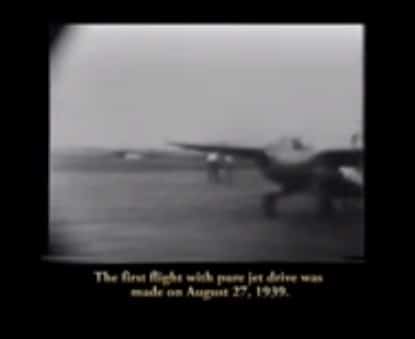
Finally, on the 27th of August in 1939, test-pilot Erich Warsitz took up the very first jet aircraft, the Heinkel He 178. Designed by Hans von Ohain and Ernst Heinkel, it was a small one-man aircraft with a jet intake in the nose and a retractable undercarriage. By now, the men agreed that the future of aircraft was the jet engine, with longer flight endurance and operational reliability than the rocket aircrafts.

Erich Warsitz’s description of the flight is amazing. His son has overlaid it (along with English subtitles) against the video of the flight:

Sadly, all research and development was halted at this time, with a focus on production. The aircraft was sent to the German Technical Museum in Berlin, which was destroyed in an air raid in 1943.

Erich Warsitz continued as a test pilot at Peenemünde-West and returned to instruction, training bomber squadrons in Nantes and Eindhoven.

The Messerschmitt 262 became the first “true operational jet plane” in 1942 and was deployed as a combat aircraft in 1944.

July 18, 1942: World’s First Operational Jet Fighter Takes Wing

Engine problems, other teething difficulties and political bungling delayed its debut as a combat aircraft until 1944, but when it arrived, the twin-jet Me 262 showed that with an experienced pilot at the controls, it was more than a match for the best Allied fighters, including Britain’s own jet, the Gloster Meteor.

In truth, the Me 262 should have been ready for front-line service much earlier. The original design, which, in the end, looked a lot like the finished product, existed as early as April 1939. But high costs and the belief of many high-ranking Luftwaffe officers that conventional aircraft could win the war prevented Germany from making the Me 262 a priority.

After the war, when you think his life would have had a chance to become boring, Erich Warsizt found real trouble. He was kidnapped from his home in the American sector of Berlin by Russian soldiers. When he refused to coorperate with the Russian jet and rocket research, Erich Warsitz was sentenced to 25 years hard labour.

He spent five years in Siberia before he was able to return to Germany. At that point, he founded his own company, Maschinenfabrik Hilden, which he ran until his retirement in 1965. He died after a stroke at the age of 76 in 1983.

The story of Erich Warsitz is an amazing one and I heavily recommend the biography written by his son Lutz Warsitz and translated by Geoffrey Brooks.

From the Amazon description:

This book is written by Erich’s son who has used his father’s copious notes and log books that explain vividly the then halcyon days of German aviation history. Warsitz was feted by the Reich’s senior military figures such as Milch, Udet and Lucht and even Hitler keenly followed his experimental flying. Little is known of this pioneer period because of the strict secrecy which shrouded the whole project – it is a fascinating story that tells of the birth of the jet age and flight as we know it today. The book includes many unseen photographs and diagrams.

If you read one aviation book this year, make it this one.

02 September 2011

The Route to an Aviation Career.

This guest post is from Stephanie of Hillsboro Aviation in Oregon, who was kind enough answer my questions about how to start an aviation career. I hope my son is reading this!

The Route to an Aviation Career

The route to becoming an employable commercial pilot is not necessarily easy. Is it worth it? That really depends on you—if it’s your dream to fly airplanes or helicopters for a living, then it probably is.

Before you start out, however, there are some things you should understand. It will likely take years before you are ready to start piloting a big, commercial airline jet or flying helicopters commercially. During this time you may be earning little money and even paying money for airplane or helicopter flight training to earn the necessary certificates that you need. If you are okay with this, then it’s never too late to start.

Education

In addition to the necessary airplane or helicopter lessons, many employers like to see that you have completed some formal education. While there is usually no official requirement that you must obtain a degree to be a pilot, it does not hurt and often helps in the recruitment process. Consider going for a math or science degree to boost your credibility in this area.

Flight Training

You will need to log a certain number of flight hours with an instructor and a certain number solo to get your first certification: Private Pilot. With this certificate, you can then work on getting either a Commercial Pilot Certificate for an airplane or a helicopter. Once you complete your commercial certificate, you can work on your Certified Flight Instructor Rating. With this rating, you can get a job as a flight instructor which is a great way to build your flight hours and pay for food at the same time. As an instructor, you can get paid to help other students learn to fly an aircraft and build up the necessary hours flying. According to Hillsboro Aviation, a flight instructor must be prepared to educate, motivate and evaluate his or her students effectively.

Somewhere between getting a private certificate and a commercial one, you’ll need to get an Instrument Rating in order to fly in conditions of low visibility. Commercial airline pilots will also need a multi-engine rating, which gives you experience in a multi-engine aircraft and an Airline Transport Pilot Certificate, which ultimately allows you to be the pilot in charge (or the captain) of a big, commercial airline jet.

After Certification

After getting a commercial certificate, your “training” may not be finished. Depending on the type of career you are seeking, you’ll most likely have to work your way up to the job you want. Airlines don’t often put freshly-certified pilots in charge of large 747s after all. With a commercial license you are ready to fly charter jets or with a regional airline, all the while getting more flight experience and more time in the sky. After that, you are ready for major airlines, where you will likely undergo more preparation directly from the airline.

With helicopter pilots, there are a lot of different options available from emergency medical services to sightseeing operations. Check out the specific requirements for the job you want, and if you do not yet fit the bill, work on getting as much experience as you can.

Conclusion

As you can see, it may take some time for you to land the pilot job of your dreams, but it is definitely possible. The best thing you can do to begin the journey is start logging as many hours in the cockpit as possible. Before you know it, you’ll be ready to take on any challenge.


If this has you dreaming of a career in aviation and you are local to Portland, you can visit HIllsboro Aviation yourself to find out more. They offer both Helicopter and Fixed Wing Flight Training and, as you can see, are more than happy to answer questions.