You are browsing the archive for: January 2011
28 January 2011

Have You Seen These?

This is a collection of things in the news and the blogosphere that made me smile today. I hope you will enjoy them too.


Someone forwarded me this Close Encounter with an Emu from Liveleaks

WARNING: this video contains strong language. Although no stronger than what I would say if this happened to me!

My favourite comment is in the description: “Wouldn’t it have been awkward to have a bird strike with a flightless bird?”


Yesterday a Tornado jet crashed into the sea off the west coast of Scotland. Both crew ejected and were rescued.

BBC News – Tornado jet crew eject before aircraft crashes

The helicopter’s pilot Iain Campbell described the rescue as a textbook recovery in perfect conditions.

He said the crew told him that they were forced to ditch after the plane caught fire at 6,000 feet.

The jet’s pilot had attempted to reach Stornoway Airport on Lewis, in the Western Isles, Highlands and Islands Airports Limited has confirmed.

A full emergency was declared at the airport but was later stood down.

Stornoway Coastguard said its helicopter located the two crew and their life rafts. It flew the pilot and navigator to hospital, reaching Inverness at about 1545 GMT.

Witnesses said a second Tornado circled the crash scene moments after the jet went down.

THE BBC has a video of the plane flying low over the Western Isles shortly before the crash and photographs of lifeboats collecting the wreckage.


I know this makes me an unabashed supporter of litterbugs but I think this Samsung marketing campaign is awesome.

Project Space Planes is a Samsung campaign to launch 200 paper places from the “edge of space.” Each plane is carrying a Samsung SD Memory Card with a message that someone, somewhere in the world has uploaded. The planes were dropped from 36,500 metres over Berlin, Germany.

The planes are being found now and the Project Space Planes has set up a Flight Log to track the planes that are found. You can follow the updates on Twitter as well.

Here is a list of locations that people have reported seeing the planes and cards in:

Minden, Germany

Bremen, Germany

Berlin, Germany

The Netherlands

Turlock, CA, USA

Winnpeg, Canada

South Africa

We’re looking into all of these reports now. How cool, huh?


I’ve decided. A MiG 29. That is what I want for Christmas.

MiG-29 Fighter Soars Over The Pacific Northwest

A former Ukranian MiG-29 fighter has become the second privately owned MiG-29 to fly, taking to the air over Washington six years after it left Eastern Europe. Capable of speeds of Mach 2.2 and altitudes of nearly 60,000ft, the Mikoyan Gurevich MiG-29 “Fulcrum” is a far cry from the 1927-57 vintage airplanes that Historic Flight Foundation specializes in restoring.

However, the opportunity to work on something so different was an irresistible lure to John Sessions, the founder of Historic Flight, who wanted to verify that a complex high-performance aircraft could be restored by following the same rules and guidelines as a vintage airplane. The resulting aircraft is one of the most pristine examples of its type anywhere in the world.

It’s around 20 years old and has 510 flight hours. It’s taken them ten years to get it into working order (including Hong Kong officials seizing in transit as military contraband and holding it for for two years) but the MiG-29 completed its first flight last week. Wouldn’t you love to be that pilot?


And finally, Sulako posted this clip in This Will Bake Your Noodles. I’m not sure what that means but I think he might be right. This interactive video by northStudio360 and Nimmo Bay allows you to use the mouse to change your viewpoint, even looking straight up at the helicopter holding the camera. Click it to start.


If you know of more aviation news or videos that will bring a smile to my face, add it to the comments. :D

21 January 2011

Phones Interfering with Flight

I’ve had this New York Times article forwarded to me a few times this week: On a Phone, Interfering With Flight Safety.

Christine Negroni writes about the routine request that passengers turn off their electronic devices during take-off and landing and that some passengers do not comply with this request.

It seems fairly clear that Negroni’s point is that we should be turning off our devices but she falters somewhat in trying to prove her case.

And really, does it matter if the devices are left on?

The answer, it turns out, is that sometimes it may.

“It’s a good news-bad news thing,” said David Carson, an engineer with Boeing. Electronic devices do not cause problems in every case, he said. “And that’s good,” he said. “It’s bad in that people assume it never will.”

That’s a fair statement: it is possible that an electronic device could cause interference. She goes on to describe the wide range of electronic devices that could be used and than older planes may not have sufficient shielding against new products. This would carry a lot more weight if we had some examples, especially if it gave a hint of what kind of “interference” we might be talking about. An annoying ping in the pilot’s headset is a different issue than an altimeter which is suddenly out of whack by hundreds of feet.

But the article moves on.

Safety experts suspect that electronic interference has played a role in some accidents, though that is difficult to prove. One crash in which cellphone interference with airplane navigation was cited as a possible factor involved a charter in Christchurch, New Zealand, in 2003. Eight people died when the plane flew into the ground short of the runway.

The pilot had called home, and the call remained connected for the last three minutes of the flight. In the final report, the New Zealand Transport Accident Investigation Commission stated, “The pilot’s own cellphone might have caused erroneous indications” on a navigational aid.

Great: a real-world example of a problem. Except that this is somewhat opportunistic reading of an accident report in order to back up the premise.

Investigation 03-004 by the New Zealand Transport Accident Investigation Commission

On Friday 6 June 2003, Air Adventures New Zealand Limited Piper PA 31-350 Navajo Chieftain aeroplane ZK-NCA, was on an air transport charter flight from Palmerston North to Christchurch with one pilot and 9 passengers. At 1907 it was on an instrument approach to Christchurch Aerodrome at night in instrument meteorological conditions when it descended below minimum altitude, in a position where reduced visibility prevented runway or approach lights from being seen, to collide with trees and terrain 1.2 nm short of the runway. The pilot and 7 passengers were killed, and 2 passengers received serious injury. The aircraft was destroyed.

Specifically, the Piper Navajo was cleared for an ILS approach for Christchurch following a Boeing 737. The last contact with the pilot was the acknowledgement that the aircraft was clear to land. At that point, he was 2.5 nm from the runway threshold and descending through 600 feet. Visibility was poor with a light drizzle and clouds at 200 to 400 feet. The plane continued to descend and collided with trees and a pasture 1.2nm from the runway threshold.

The aircraft descended and impacted the ground just over a mile before the runway.

Further detail: a phone call was made from the pilot’s cellphone to his home during the approach.

Now make no mistake, this is bad news. New Zealand Civil Aviation Rules explicitly ban pilots from the operation of “cellphone or other portable electronic device that is designed to transmit electromagnetic energy” for IFR flights. And it is true – the CAA have shown that onboard cellphones can interfere with electronics.

At high signal levels, similar to that attainable from a cellphone 30 cm from the equipment or its wiring, anomalies were produced on all equipment readings except the glide slope indication.

We’re veering away from the NY Times focus on passenger electronics but let’s continue with this accident report for a moment. The question: did the pilot’s phone interfere with the airplane navigation as a factor in the crash?

It is correct that Investigation 03-004 by the New Zealand Transport Accident Investigation Commission (TAIC) does mention the possible interference caused by the pilot’s phone but more in terms of “covering every eventuality” than because of clear interference due to use of electronics. In the summary report, however, this isn’t mentioned as a probable cause. The pilot probably was distracted from monitoring his altitude upon approach. The summary also mentions that is is possible (although unlikely) that the pilot was incapacitated during the final stages of the flight through a heart-attack. Electronic interference doesn’t warrant a mention.

It is discussed in the full report. Let’s pay special attention to the reference to cellphone interference with the navigation equipment, even though the report summary does not support this as a probable cause.

The possibility of a faulty G/S indication is unlikely to be resolved. While the aircraft was reportedly serviceable, some defect could have occurred since the last use of the ILS equipment in ZK-NCA. Normally a failure of the G/S receiver or indicator would produce a “G/S OFF” flag, so the pilot would know to follow a different approach procedure, such as a localiser approach. A possibility must remain that even with a serviceable G/S system, interference from the pilot’s own cellphone might have caused erroneous indications, perhaps without activating the “G/S OFF” flag. The pilot’s cellphone was the closest to the aircraft equipment, and was the only one operating during the approach. The potential for electronic interference increases with the closeness of the cellphone to the G/S receiver, indicator and associated wiring. The susceptibility of the system to interference is not quantifiable, and logically will vary with the condition of the wiring and screening in individual aircraft. Although the UK CAA tests did not demonstrate interference with the G/S, they did not rule out the possibility; they did confirm cellphones as an interference source to this general class of avionics equipment.

So yes: it is possible that the phone was close enough to interfere with the glide slope indication. It is possible that that the indicator did not react as expected by showing itself as “G/S OFF”. None of the tests recreated this interference; however they were not able to rule out the possibility that it could have happened.

Accidents are rarely down to one simple mistake but the report does not appear to take the cellphone interference seriously even as a possible probable cause. Instead, they specifically fault the pilot’s set-up for the approach.

The pilot chose to descend in a fast approach, which is often requested to get smaller aircraft out of the way. However, a fast approach is only acceptable in good weather and visual conditions, which was not the case. Also, the approach in bad weather would have been easier done using the auto-pilot for a coupled approach – a decision taken by the Boeing in front. The pilot of the Navajo disengaged the autopilot at the beginning of the instrument approach, with “little time to settle in”. Neither ADF onboard was tuned for the missed approach. The report is very clear that the pilot showed “some lack of method in his procedures, or distraction, or possibly an intention to persevere to land from the approach without regard to weather conditions.” And again, the cellphone call is mentioned: as a severe distraction.

The pilot’s altimeter was a standard barometric/mechanical instrument, and was not susceptible to electronic interference from his cellphone or any other source. [...] The conclusion from this is that the pilot allowed the aircraft to continue descent below the prescribed minimum altitude when he had accurate altimeter information, and when visual reference with the runway or approach lights was not available to him.

In other words, the electronics on the phone did not cause the bad decision.

The only possible explanations for the pilot allowing the descent to continue in these circumstances are:

  • some major distraction, which led the pilot to overlook monitoring the aircraft’s altitude
  • an intention to persevere with the approach below minima
  • some partial level of incapacitation or impairment of the pilot, so that he was unable to either comprehend the aircraft’s altitude, or to arrest its descent.

So yes, the accident report mentions the pilot’s phone (which should not have been in use) and concedes that there is a possibility that the electronics may have interfered with the glide slope indicator (although no such interference has been recreated in tests). It also states directly that this was not the cause:

The aircraft’s continued descent below the minimum altitude could not have resulted from electronic interference of any kind.

Honestly, if this is the best example you can find to show that passengers using electronics onboard airplanes is dangerous, then you are on shaky ground.

Returning to the New York Times piece, Negroni shifts to the FAA.

On a Phone, Interfering With Flight Safety – NYTimes.com

The Federal Aviation Administration says there are risks associated with electromagnetic interference and prohibits the use of electronics below 10,000 feet because pilots have less time at lower altitudes to deal with a problem. It is up to each airline to set the policy at higher altitudes. “There’s not enough evidence to warrant a change,” said Les Dorr, a spokesman for the agency.

We almost hit a sensible point here. The take-off and landings are the critical phases of flight. Reducing variables at this time makes sense and although the chances that an unexpected device in the back of the plane could create unknown interference are slim, it is clearly possible. More importantly, the rule helps passengers remain focused on their environment – the request not to wear headphones during this time is not because it might be an iPhone transmitting electromagnetic energy but instead to ensure the passengers keep situational awareness and are not blocking out important messages from the flight crew.

Instead, the New York Times article continues to focus on the risk of electromagnetic interference.

Still, Mr. Strauss said the deterioration of planes and devices over time had not been taken into account. “A plane is designed to the right specs, but nobody goes back and checks if it is still robust,” he said. “Then there are the outliers — a cellphone that’s been dropped and abused, or a battery that puts out more than it’s supposed to, and avionics that are more susceptible to interference because gaskets have failed. And boom, that’s where you get interference. It would be a perfect storm that would combine to create an aviation accident.”

Boom! indeed. I’ve seen worse articles but this does seem intent on scaremongering with very little basis to back up the issue.

There is a clear moral to the article but I don’t think it is one that Negroni intends. Should you use your smartphone during take-off and landing? No, you should not – especially if you are the pilot.

14 January 2011

Travel Woes

I’ve been running around like a mad woman all week so I’m afraid I don’t have a real post for you. To make up for it, I made this mosaic of iPhone photographs I took today travelling from Heathrow to Malaga:

Meanwhile, if you are looking for something interesting to read, I highly recommend this series on Alaska Dispatch:

Part One: Seasoned Alaska pilot recounts Knik Glacier crash landing

Part Two: ‘Perfect storm’ of deadly conditions tested Alaska pararescuers

Part Three: Another aircraft crashes before successful rescue from Alaska’s Knik Glacier

Max Trescott has written up a summary of the articles if you want the short version: What all Pilots Can Learn from Alaska Plane Crash Rescue

Now, I’m off to unpack my suitcases and collapse in a heap.

07 January 2011

Human Factors: Crossair Flight 850

Human Factors: an airworthy aircraft involved in an accident caused by decisions taken by people. The pilot in command, in the end, is held responsible, whether the errors in question are latent or active. The pilot in command carries the final decision over the safety of the flight and the landing.

Statistically, we distinguish between pilot error which is weather related and pilot error which are caused by or lead to mechanical issues. In addition, we have other human error which relates to air traffic controllers, weather reporters and operations staff.

In the incident of Crossair Flight 850, in which a Saab 2000 was written off, the answer appears to be “all of the above”.

The Bundesstelle für Flugunfalluntersuchung (German Federal Bureau of Aircraft Accident Investigation, also known as BFU) released their report on Crossair Flight 850 last month. The sequence of events makes for a remarkable read, where just about every person involved could have reacted better. It is a textbook example of the holes lining up, leading to the wheels being ripped off of a Saab 2000 in a small airfield in Germany in visual conditions. Every individual issue was minor … only as they converge do we end up with the house of cards falling down.

On the 10th of July 2002, a Saab 2000 and her crew were assigned at short notice for the Basel to Hamburg flight, which had been scheduled to fly with an Embraer 145.

They had weather reports (METARs, TAFs, wind charts) valid to 18:00 UTC which showed that they could expect some thunderstorms en-route. They took on an additional 570kg of fuel in case they had to wait out a thunderstorm over Hamburg, which could close the airfield for 20-30 minutes. There was no reason to expect any unusual or extreme weather based on the information the crew received.

However, a SIGMET (Significant Meteorological Information) was issued at 15:00 UTC for Bremen UIR and FIR, including their destination area: a line of thunderstorms advancing northeast and extending up to flight level 380. The flight crew were involved in pre-flight preparation and did not see the SIGMET nor the additional warnings of thunderstorms for the area to the east of Bremen. The flight did not depart until 16:09 UTC, over an hour after the Bremen SIGMET was released.

Note: the accident report uses local time for the flight which I have converted to UTC for consistency. All times in this document are given in UTC.

Issue Number One: The Operational Control Centre did not notify the crew of extreme weather warnings in the destination area.

The BFU is of the opinion that if they had been available, these SIGMETs would have alerted the crew that these were not isolated thunderstorm cells, but a thunderstorm front of considerable proportions. This knowledge might have had an influence on the decisions made by the crew during the flight.

The BFU is of the opinion that the fact that the SIGMET issued at 15:00 UTC … did not reach the aircraft even though it remained on the ground until 16:09 UTC (1809 hrs), indicates that the operator’s Operational Control Centre provided insufficient support.

16:09 Crossair Flight 850 departed Basel
17:36 The flight is cleared to descend to 3,000 feet for an ILS approach into Hamburg runway 23
17:38 As a result of severe turbulance, the flightcrew aborted the approach into Hamburg at 3,300 MSL
17:41 The flight entered a holding pattern to see if the weather cleared so they could land at Hamburg rather than divert.
17:49 The crew requested a diversion to Hannover, their second alternate.

While in the holding pattern, the crew had time to consider their next decision. The accident report gives the following list of options:

  • Another approach to Hamburg
  • Approach to one of the standard alternate airports
  • To consult the FMS data base for another suitable alternate airport (NAV-Display)
  • Make contact with the OCC and request support
  • To consult air traffic control with a request for suitable alternatives

Having decided not to attempt a further approach into Hamburg, the flightcrew contacted ATC to ask about their planned diversion airfield, Bremen. It was also beset with thunderstorms and although the storms were passing, it would involve the flight attempting to penetrate the front. They decided instead to fly to their second alternate, Hannover.

Issue Number Two: Whilst in the holding pattern, the crew had ample opportunity to get a full picture of the surrounding area. They did not ask ATC about other airfields in range nor for updated information about the weather in the area. In fact, at that point Lübeck was immediately below and free from storms, while Hannover was already behind the cold front. However, the crew blindly followed the flight plan.

If there could be no landing at the original declared destination, a diversion to a predetermined alternate airport is a standard operating procedure. Because Bremen was behind the weather front and the crew was not prepared to penetrate the front or fly around the frontal area, the decision to divert to the second alternate – Hannover, which by that time was also behind the cold front – is not understandable. This shows the BFU that the list and sequence of alternates was followed diligently instead of trying to get an idea of other options and possibilities.

17:52 Crossair Flight 850 left the holding pattern and proceeded towards Hannover. The flight encountered further thunderstorms and the crew realised they would not be about to fly around the storm cell to reach Hannover.
18:13 The crew aborted the flight to Hannover and requested a diversion to Berlin-Tegel, which showed on their weather radar as clear of the storms.
18:15 Berlin-Tegel ATIS information cited the weather as CAVOK (Ceiling And Visibility OK) with NOSIG (NO SIGnificant change expected).

Issue Number Three: The recorded weather information at Berlin-Tegel was incorrect. The approaching weather was already recognisable when the report was assembled. It is incomprehensible why a NOSIG – a forecast that the situation would remain unchanged for the next two hours – was included. In addition, the ATIS was not updated as the storm front approached.

In the 30 minute time period between the two routine weather reports, weather conditions worsened considerably. The worsening weather conditions resulting from the approaching cold front were recognisable and did not occur totally unexpectedly. The BFU is of the opinion that it would have been appropriate to issue a SPECI report in the period between 17:50 UTC (1950 hrs local) and the next routine weather report at 18:20 UTC (2020 hrs local).

18:17 Crossair Flight 850 established contact with ATC at Berlin
18:18 Crew received a low-fuel warning and requested priority approach, stating that they only had fuel remaining for 40 minutes. They are given instructions for runway 08.
18:20 Berlin-Tegel weather is updated with TEMPO, including warning of thunder showers
18:26 A SPECI (a SPECIal unscheduled report) was released as the line of thunderstorms reached Berlin
18:28 Crossair Flight 850 aborts the approach owing to turbulence and requests further airport options in the area. Berlin ATC recommend Eberswalde-Finow which was 27NM away.

From this point, the flight was treated as an emergency because of the low fuel warnings. However, Eberswalde-Finow was also hit by the thunderstorms.

18:32 The crew requested information on airfields cited in the onboard Flight Management System and changed heading towards Neubrandenburg, 46 NM away.
18:34 Berlin ATC report a thunderstorm over Neubrandenburg. The weather was reported to be clear east of Berlin and ATC recommend a heading towards Werneuchen, 20 NM away.

Werneuchen was not in the Flight Management System and so the crew did not have a chart for the airfield. However, they were running out of options.

Because of the changing weather and the necessity to alter track several times, the crew found themselves in a situation where, instead of a routine diversion to an airport, the shortage of fuel and the weather situation made a precautionary landing necessary at any airfield with a suitable runway. Although it was still unlikely that an engine would stop very soon because of lack of fuel, there was hardly any other alternative. The crew therefore accepted an airfield that was totally unknown to them, Werneuchen Special Airfield.

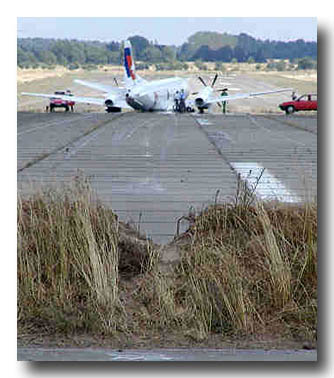
ATC contacted the chairman at the flying club. Werneuchen was a former military aerodrome which has been used by civil aircraft since 1990. The original length of 08/26 was 2,400m x 80m. The chairman took the call on his mobile phone and warned ATC that the western end of runway 08 included a displaced threshold. The usable runway at Werneuchen is 1,500m with an earth wall erected to curb the problem of illegal car races.

As a precaution against unauthorised access, the aerodrome operator was given permission by the regional Civil Aviation Office to erect an earthen wall no more than four metres high at the western end of the ex-military airfield. In addition, a 70 cm high wall of heavy clay was placed across the entire width of the runway about 235 m west of the threshold to Runway 08 and about 770 m from the western end of the ex-military airfield.

Issue Number Four: Communication breaks down regarding the displaced threshold. The ATC supervisor was under the impression that there were two runways at Werneuchen. He told the controller, “…he should not take the short runway, there is an earth wall after five hundred metres.” The controller had the aerodromechart but it made no reference to closed runway markings on the disused sections of the old runway. Further, the aerodrome chart bore no markings denoting the displaced threshold to runway 08. The controller passed the runway data to the crew and relayed the message from his supervisor.

The contents of the message were incomprehensible for the flight crew without having the possibility of checking or interpreting the approach and runway plates. The choice of the word “should”, would normally be understood by the crew as a recommendation, and was therefore not perceived as a warning. The message contained none of the key vocabulary with which the crew would have been familiar, such as closed portion, obstacle, blocked, displaced threshold.

18:39 Werneuchen: “And there is an earthen wall, so he should pay attention, that he does not attend er does not land on this five hundred meter strip – he should land on the one thousand five hundred metre strip”
18:39 ATC Supervisor: “Yes good, he’ll do that anyway”
18:39 ATC controller to Crew: “We just eh been informed that you should use the easterly part of the runway eh so eh in you eh you are not before landing before the threshold of zeroeight – genau.”

Issue Number Five: The runway markings were no longer clear. The military runway markings were clearly visible, as you can see from the Google maps image of the airfield. The crosses painted on the disused area had eroded. From a visual point of view, it was not clear that any part of the runway was closed, even on direct approach.

Clear marking of flight operation areas, in particular runways, is an essential safety mechanism for the prevention of accidents. A runway must be clearly visible for pilots in the air, and distinguishable from other flight operation areas. The markings at Werneuchen Special Airfield did not meet the requirements or recommendations of ICAO Annex 14, or the national regulations then in force.

18:40 Crew: “Ja we’re just abeam the threshold zero-eight now making a left hand eh downwind if you agree for zero-eight.”

Issue Number Six: The crew had never been to this airfield and did not have a chart or any information other than what had been passed on by ATC. Standard procedure would be to overfly the runway but, no doubt as a result of the deteorating weather and concern about the fuel, the pilots never discused this but instead flew straight in. Although the runway markings were not clear, the earthen walls should have been apparent if the crew had flown along the runway for a visual check. The conditions were VMC at this time.

At 20:40 the crew reported Werneuchen in sight and lined up for an approach to Runway 08. They did not have the frequency for the Airfield and continued to speak to Maastricht Upper Airspace Control. The crew approached runway 08 directly without radio communication with the airfield and – due to the weather and shortage of fuel – without first inspecting the runway from the air.

And now the stars are all in alignment for the wipe-out of the Saab 2000.

20:41 Final approach of Crossair Flight 850 into Werneuchen Runway 08

The co-pilot, who was the pilot flying, asked, “Touch down where?” The PIC answered, “Where-ever you like, my friend.”
After passing through 500 ft AGL the PIC said: “It’s longer than … “It’s longer than… longer than Bern, hä.“

Bern is 1,510 metres – the same length as available in Werneuchen. The crew never realised that there was a displaced threshold. They were reacting to the original military runway (2,400mx80m) rather than the 1,500m usable runway. It was not until immediately before the collision that the crew could see the earth wall across the runway.

20:42 The Saab 2000 touched down and collided into the earthen wall. All three landing gear legs broke off. The aircraft slid 350 meters and then came to a halt.
The crew opened the doors and the flight attendants evacuated the passengers. Only one minor injury was sustained.
21:00 The thunderstorms passed over the airfield with wind gusts up to 52 knots.

The BFU cite the following direct causes of the accident:

Immediate Causes:

  • The extent and intensity of the thunderstorm frontal system, plus the speed of change in the weather system.
  • Insufficient use of available resources when making decisions in flight (pro-active).
  • The loss of alternative landing options, coupled with increasing time pressure (reactive).
  • Aircraft touched down outside operational area of an airfield.
  • Earth wall was not detected, followed by collision with the same.

Systematic Causes:

  • Insufficient information with respect to weather situation and development, both prior to and during the flight
  • Insufficient information about Werneuchen Special Airfield due to inadequate chart illustration, plus absence of and misunderstood communications
  • Insufficient signs and markings of operational and non-operational airport areas.

No safety recommendations were made.

From the first moment, when the SIGMETs were not passed onto the crew, the options began to narrow. The crew took on an additional 570kg of fuel to deal with delays, enough for approximately 45 minutes additional flight. At Werneuchen, the Saab 2000 had 420 kg of fuel remaining in its tanks. In the end, a series of questionable choices and bad information meant that the flightcrew felt pressured to land in a rush on an airstrip for which they had no details.

The Saab 2000 was a write-off, and although weather (especially thunderstorms) are frequently a problem for pilots, the loss of the plane in this instance was solely an accumulation of human factors.

Until this point, the ATC Supervisor was of the impression that the chairman of the flying club was on site at Werneuchen. It was only after ATC lost contact with the plane that he realised the error. He hung up to call the fire brigade and then phoned the Werneuchen number again to ask if maybe the chairman would drive out to the airfield to see what happened. “No, it would take me an hour and a half to get there,” said the chairman. “There is only just one, he is seventy eight or eighty years old but is very mobile. But he could drive out, should I ask him to do so?”

The full accident report is available in English as a PDF on the Bundesstelle für Flugunfalluntersuchung website.


If you found this post interesting you might enjoy the following:


If you enjoy this blog, consider buying my ebook: You Fly Like a Woman for under a dollar at Amazon.