You are browsing the archive for: November 2009
27 November 2009

Stick in the Mud

Shobdon Airfield started as Pembridge Landing Ground, a long strip in an isolated area used to support Army manoeuvres. In 1942 it was upgraded to “a proper airfield” by the military.

Shaun McGuire has made a website dedicated to the Hereford Parachute Club at Shobdon and has reprinted an article found in Action Stations 3, The Airfields which tells the history of the airfield:

The first visitor after the new airfield opened on May 28, 1942 was a Grumman Martlet which forced-landed whilst on a flight from Yeovilton to Donibristle on June 20. A few days later two Canadian Spitfires landed after getting lost on a cross-country flight. On July 14 the first aircraft to be based – a Lysander – was delivered by an ATA pilot, followed by two dismantled Hotspur gliders brought by road.

I was flying to Shobdon on a whim. Its location on the border of England and Wales meant I was likely to get some lovely views and the attached café had a good reputation. At the time, I didn’t think to look at the history of the airfield, or else I might have seen this:

Shobdon’s grass surfaces on which the gliders usually landed were muddy and unserviceable and half the runway width was unusable because of re-surfacing work.

I was blissfully unaware that the airfield had a reputation for mud when I planned a day trip to Shobdon and back, I was just pleased I could conveniently get my three take-offs and landings in a single afternoon.

Shobdon has a hard runway, over 2,700 feet of asphalt, so I wasn’t particularly interested in the state of their grass. I felt much more prepared than I usually was, as I’d met someone at my local flying club who knew the airfield well.

“Keep a good look out,” he told me. “You get the fighter jets over-flying the place without bothering to talk to anyone. Check the noise abatement procedure, it’s a wide circuit there. And always, always watch the other planes: they have two overhead join procedures: one for locals and one for people who know what an overhead join is.”

He also told me that air-to-ground was “intermittent” so I wasn’t concerned at the radio silence when I approached the airfield later that afternoon. It was quiet, no other planes in the air and no sign of military activity. I landed without any excitement and head over to the clubhouse to get some lunch.

It seemed a nice enough place – the café was tidy and the people were friendly. I got lost looking for the restrooms and ended up in room at the back which seemed the epitome of a Victorian gentlemen’s lounge: wood panelled walls, dark green furniture, varnished tables with crystal ashtrays large enough to hold a cigar or two. I felt quite guilty being in there, an intruder in a masculine world that I’d only ever read about. I backed out nervously before anyone caught me touching the velvet curtains.

A friendly woman in a small wooden cubicle accepted my landing fee and commented what a lovely day it had been and how lucky I was. The week before had been miserable, she told me, non-stop rain. I chatted to her for a bit and then made my way back to the plane.

It was lunchtime and the café had just begun to fill. I’d seen a table full of old airmen, no doubt telling tall tales of the type I love to hear – but I needed to get back home. I settled for a quick cup of coffee at the table next to them. One day I will learn to appreciate tea – after all these years in the UK, you’d think I’d have acquired a taste for it.

I rushed back onto the apron and started up the plane. There was still no one on the radio so I did my calls blind. I was meandering along the taxi-way when I belatedly noticed the sign: “No power checks beyond this point!” I looked around. No other planes were moving. I turned the plane hard to the right so that it was somewhat vaguely into wind and started my checks on the spot.

When I went to turn back onto the taxiway I realised I hadn’t left myself any room to make the turn, I was going to have to enter the grass runway which ran alongside the taxiway. But in that case, I thought, why not just cross the grass and head directly to the asphalt. The radio was silent, no one was coming in, it wasn’t like I was going to be causing any inconvenience.

I made the call and pulled onto the grass. The plane bumped forward and then slowed to a crawl over the uneven ground, losing momentum. I pushed in the throttle but it seemed I was too slow, the plane stopped moving. I increased the power again and then once more. It took a moment before it sank in: I was at full throttle and the plane wasn’t moving. I bit my lip, shut down the engine and clambered out of the plane.

"Didn't anyone tell you?"

There was no denying it, I was stuck. There was a 3-foot long furrow in the mud. I closed my eyes, I could almost hear the swearing of the future gliders landing on that runway.

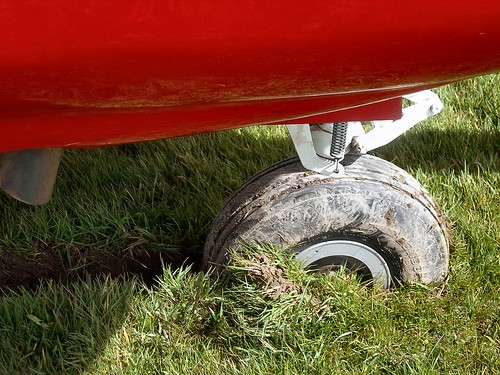
At the end of the rut was my nose wheel, covered in mud and dug into the grass. The propeller had bright green streaks all around the edges. If I’d managed to go any deeper, I would have probably taken out the prop but luckily, no damage was done. Except that I needed to get the plane off of the grass somehow.

Help appeared rather rapidly, a plane shutting down perpendicular to the taxiway and runways has that effect. A friendly, sturdy looking guy came out from wherever he had been working to see what had happened.

“The grass runway isn’t usable after the weather we’ve had,” one said, looking at the plane. “It’s a bit muddy out there.” Yeah, I’d noticed. I showed him the nose wheel and he grimaced. Others arrived and a moment later there were four of them in a circle around the Saratoga, shaking their heads at the mess I’d gotten myself into. I stayed on the periphery, they looked like they’d spent their life around planes and were probably taking them to pieces while I was still hoping I’d grow tall enough to be a stewardess. I didn’t think they’d appreciate my input and I didn’t have a chance of getting the plane out without them.

“She’s stuck, all right.”
“If she used full power, couldn’t she…”
“No way, look how close her prop is to the ground already.”

I couldn’t help nodding furiously in agreement every time someone vetoed the “full power and press on” theory.

“Can we push her?” They circled around the plane. I was pretty sure that the female pronoun referred to the plane, not me. I checked to make sure no one was shoving a part of the plane that shouldn’t be shoved, then positioned myself at the nose to heave on the count of three.

The Saratoga rocked backwards and then hit the side of the ridge and lurched forwards again, comfortable in its rut. We could push it out, if we could follow the muddy crevasse I’d created exactly. As it was, we weren’t creating the momentum to push the nose wheel out and over the rut. Even with six of us, it was not enough.

One of the men looked as if he might mention the full power theory again but my new friend who had taken charge spoke first. “We’re going to have to tow her out.”

I didn’t have a clue what this would entail and how this would work. In the end, I simply admitted my helplessness. “I guess I’m not much help.” I got a tolerant smile as a response. I took a chance. “Would it be OK if I took a few photographs of you pulling the plane out?

We don't need no stinking tractor

Luckily they were a friendly bunch; they grinned at me, happy to be captured on film as they rescued this damsel in distress. A battered Landrover was quickly sourced to tug the plane out backwards. They affixed the rope to what we all thought was a tow point on the back of the plane. I later discovered the handy loop was actually for tying the plane down – to my dismay I discovered that the handbook specifically warns against using it to tow. It’s probably a good thing that I didn’t know this while the men positioned themselves: one at the nose of the plane, one at each wing, one in the Landrover and one to stand with the rope. On the count of three, the men shoved, the driver revved carefully and the Saratoga shuddered gently before majestically lifting up and over the rut and then rolling smoothly back to the taxiway. The Landrover towed her back to the sign: “No power checks beyond this point!”

From there it was easy. I thanked them all profusely and did a quick walk-around. Everything looked fine, even the tie-down point. I got into my plane and flew back home, impressed at how friendly everyone had been. I made a mental note to come back to Shobdon … in the summer, after it’s had a chance to dry out.

20 November 2009

Don’t Block That Frequency

I’m on the road this week but never fear! The well-known aviation blogger Plastic Pilot has kindly taken command of Fear of Landing for the day. I asked him to tell us what it is like in Air Traffic Control and he responded with the following post.

ATC Behind the Scenes

by Vincent, the Plastic Pilot

I’ve been working for ATC companies for the last nine years and gained a good understanding of how the whole system works, from both sides. Knowing what a controller working position looks like and how the guys on the other side of the radio are working makes the cooperation easier. This is what I’d like to share in this post to make you feel better when you talk to ATC…

Controllers are supported in their tasks by different systems: surveillance systems (radar, ADS-B and others) inform them about the aircraft positions, this information is linked with flight plan data.

NewcastleOther systems provide controllers with so called “environment information”:

  • weather,
  • runway in use,
  • military airspace,
  • NOTAMs,
  • and so on.

But all this nice technology becomes totally useless if the controller loses his ability to communicate with the pilots. This is why the radio system is the most important for controller.

The radio system on the ATC side is exactly the same as in the cockpit: a controller can transmit or receive, but not both at the same time. If you talk, the controller must listen and wait till the end of your transmission. There is no override or bypass system. This is why controllers hate it when their frequency get blocked.

StrasbourgLet me tell you a short story I saw once, directly from the tower…

An Airbus 320 was lined-up, ready for take-off. The controller was waiting for the preceding landing to vacate the runway before issuing the take-off clearance. A Boeing 737 was on short final. The timing was short, but not critical. At the very moment where the controller was ready to clear the Airbus for take-off, an incoming VFR pilot started a transmission.

The pilot did not use the standard “Tower, Call-sign, good morning” initial contact message. Instead, he started a very long transmission, not using ICAO phraseology. I don’t remember the very words he used, but it was something like “Tower good morning, this is HB-XXX… a PA28 we took off from LSXX and we are requesting landing clearance. We have two persons on board. We also copied airport information Quebec and are approaching VRP N”. The message was excessively long, and sounded anything but professional. During the time the frequency was blocked, the 737 on final had to go around, because the A320 was still standing there, by lack of landing clearance.

AngoulemeWithout a radio, a controller becomes a simple spectator…

If the VFR pilot had use a short initial contact, the controller would have answered with a “Stand-by”, and then cleared the 320 for take-off, and the 737 to land, shortly after. I’m sure you don’t want to be this kind of pilot, so please use standard phraseology and keep your messages short.

VFR pilots mostly use ground, tower and approach frequencies, where pilots can hear each other, thanks to the relative small size of the airspace served by these frequencies. It is a good radio practice to wait for a couple of seconds before initial contact on a new frequency, to make sure you won’t interrupt some other radio exchanges. When contacting an “Information” frequency, an additional problem exist: given the size of the areas served by one single controller, possibly using multiple frequencies, the risk of simultaneous transmission is increased.

MarrakeshDepending how sophisticated the radio system is, it is possible for a flight information service officer to work several frequencies simultaneously, but this is not always the case. When you make your initial contact, it is possible that the guy on the other side must try different transmission frequencies to answer your call. He can also be talking to someone else on a frequency you don’t monitor.

One more thing for VFR pilots… Remember that if you fly without a flight plan, controllers do not have any clue who you are and what you want to do. They have to note down everything you say on the fly, so please don’t talk too fast when you pass your message. It’s much better to transmit once, slowly and clearly, than too fast and have them requesting all information again.

Finally, if you have the opportunity to visit a local ATC facility… just do it. You will be well received and will learn a lot. Controllers like to talk to pilots, even if this is a bit more complex than before September 11th. Look for ATC open house day at your local airport and don’t miss it.

Be sure to visit PlasticPilot’s General Aviation Blog and thank him for this insider’s view of the tower. Also take a look at his exciting initiative Flying Across America with a plan to fly from Daytona Beach, FL to Catalina Island, CA and back.

13 November 2009

Military Jet Buzzing Santa Monica Pier

Last November, two high-performance military jets departed Van Nuys airport in California as a formation flight to gather footage for a film in production called Kerosene Cowboys. The plan was for the jets to do four passes off of the coast of the Santa Monica pier, west of a banner tow aircraft towing a banner for the film. The first passes went as planned and then one of the pilots broke away and flew low over the beach area for multiple passes in excess of 250 knots (two of the passes were below 500 feet) and then pulled into a steep climb just before the pier.

Buzzing of Santa Monica Pier leads to questions about aviation safety — latimes.com

Racing at speeds of up to 350 mph, the Soviet-made military jet made several low-altitude passes at the Santa Monica Pier, seemingly keying on the popular Ferris wheel as frightened onlookers scattered, some screaming.

Emergency calls poured in to police as the aircraft flew about 50 feet off the ground, then spiraled skyward in a series of tight rolls, smoke trailing from its tail as if it were an aerobatic plane. The lifeguard in Tower 26 said the jet passed so close that she felt a wall of heat.

David Riggs and Skip Holmes were the pilots of the military jets. The pilot in question of the lead aircraft that broke away was identified as David Riggs.

A video of the event:

The jet pilot has had his private pilot certificate revoked.

Flightwatch

The pilot in question was cited for a number of violations of the Federal Aviation Regulations including the following:
a. Section 91.117(a) [flying at an indicated airspeed of more than 250 knots below 10,000 feet];
b. Section 91.117(c) [flying at an indicated airspeed in excess of 200 knots while operating below Class B airspace];
c. Section 91.119(a) [operating at an altitude where an emergency landing cannot be effected without undue hazard
to persons or property];
d. Section 91.119(b) [operating over a congested area below 1,000 feet above the highest obstacle within a horizontal radius of 2,000 feet];
e. Section 91.119(c) [operating at an altitude of below 500 feet over an other than congested
area];
f. Section 91.303(c) [performing aerobatics in Class B, Class C, Class D or Class E Airspace];
g. Section 93.303(d) [conducting aerobatics within 4 nautical 3 miles of the centerline of a
Federal airway];
h. Section 91.303(e) [conducting aerobatics at an altitude of below 1,500 feet above the
surface]; and i. Section 91.13(a) [operating an aircraft so as to endanger the life or property of another].

The pilot stated that he was doing the flybys to promote his new movie; there was a meeting including “film market buyers and producers” at the Loew’s Beach Hotel overlooking the pier. Dave Riggs is the CEO of Afterburner Films, Inc.

You can read the full details on a PDF by National Transportation Safety Board (may be slow to load).

And that would seem to be the end of that. Although according to the LA Times article:

FAA officials also say they are still keeping an eye on Riggs. In August, they sent him a warning letter stating that the agency would not honor a Canadian pilot’s license he obtained in June, several months after his U.S. license was revoked.

Here is a photograph of the plane (taken by Chris Kennedy and featured on Airport-Data.com):
248717

If you think it looks vaguely familiar, that might be because you’ve recently watched the viral YouTube video about a frightening Close Call with Terrain:

Is it the same plane in the video?

The markings match but I don’t know how common that colour scheme is for L-39s and there’s no chance of seeing the registration number. I’ve been looking for more information on the terrain incident but not seen anything other than the details on YouTube so far.


If you enjoy this blog, consider buying my ebook: You Fly Like a Woman for under a dollar at Amazon.

06 November 2009

All I Need is the Air that I Breathe

Sylvia in the SaratogaOne question I didn’t deal with in my Frequently Asked Questions was whether the Saratoga has oxygen. The plane does have an oxygen tank and you can plug masks in on the ceiling to take it in directly. We’ve never used the supplemental oxygen other than to test to make sure it’s really there. The plane is not pressurised and we very rarely fly high enough that it is an issue.

What is the issue? Hypoxia: oxygen deficiency. The altitude at which pilots can be affected varies based on a number of issues including health, age and training.

Hypoxia (medical) – Wikipedia, the free encyclopedia

Symptoms of generalized hypoxia depend on its severity and acceleration of onset. In the case of altitude sickness, where hypoxia develops gradually, the symptoms include headaches, fatigue, shortness of breath, a feeling of euphoria and nausea.

F16 pilot wearing maskThe onset of hypoxia is often masked by the euphoria – you have a general sense of well-being and can be apathetic to the fact that something has gone wrong. You will feel confused and disoriented. Your time of useful consciousness is limited – the time in which you remain capable of making sensible decisions and correcting the issue.

A recent and well-known hypoxia incident was the crash of Helios Flight 522, in which the flight crew were incapacitated due to hypoxia. The plane flew into a holding pattern over Athen’s International Airport and after the sixth loop, two Hellenic Air Force F16s flew to intercept. One of the F16 pilots was able to see into the cockpit: the Captain’s seat was vacant and someone was slumped over the controls in the First Officer’s seat.

You can read the full details on the Final Accident Report (in English). There were, as always, a series of factors that led to the final crisis and the detailed analysis makes for interesting, albeit chilling, reading.

However, hypoxia is not just an issue for high-level jets. As a part of my UK PPL, I was told to start considering hypoxia symptoms whenever I flew over 8,000 feet and to actively be monitoring the risk at all times over 10,000 feet. The FAA has a specific regulations for flights over 12,500 feet. The flight crew must have supplemental oxygen available and use it when the flight is at a cabin altitude pressure of 12,500 to 14,000 feet for more than 30 minutes. Above 14,000 feet the flight crew must use supplemental oxygen for the entire duration of the flight at that altitude.

The passengers aren’t required to have their own oxygen supply until the cabin pressure altitude is above 15,000 feet as they hopefully are not making critical decisions. Personally, I’d ask for my fair share on any flight over 12,000.

A tragic VFR case in 2003 involved a PA-28 flying over the Rockies. You can read the full accident report from the NTSB – again a number of issues came into play. The pilot was delayed due to bad weather and changed her planned routing to avoid further weather. She requested an altitude of 15,500 feet. The PA-28 was unpressurised and did not carry supplementary oxygen. Radar data indicates that the pilot flew above 12,500 feet for 2 hours, 17 minutes, above 14,000 feet for 1 hour, 49 minutes, and at approximately 16,000 feet for an estimated 45 minutes.

While flying above 14,000 feet, from 18:42 to 20:31, the pilot received numerous heading corrections from ARTCC, some of them by as much as 70 degrees. On one occasion, the pilot reported that she was over Montrose, Colorado, and the ARTCC informed her that she was over Telluride, Colorado. The pilot responded with “roger that, I appreciate it, can’t see a darn thing out here.” The radio communication between the pilot and ARTCC became increasing difficult and erratic. Many other aircraft assisted in relaying information between the two.

The radar data showed that she began to descend rapidly (1,077 feet per minute) and five minutes later made a mayday call – possibly the result of the increased air pressure as she returned to below 10,000 feet. She had come to her senses too late.

At 20:35, the pilot transmitted the following: “Denver radio, mayday, mayday, I’ve got myself in (unintelligible).” At 20:37, a Federal Express flight 1290, flying in the area, said “yeah, we just picked up a strong Emergency Locator Transmitter (ELT) signal on 121.5, it’s gone now.” The ELT signal was not received again. On the morning of January 25, 2003, at approximately 09:30, a rancher observed a column of smoke on his land. Upon investigation, he discovered the downed airplane.

Fuel ConsumptionHer flight plan was never viable. She shouldn’t have been at that altitude without supplementary oxygen but also she’d planned a 4-hour flight based on having 8-hours of fuel in the plane. In all actuality, with the most efficient fuel burn, the flight required 5 hours and 25 minutes – in an aircraft with 5 hours maximum endurance.

In addition, she had a strong headwind. She lost total engine power due to fuel starvation and she was not in a mental state even to realise the issue until the plane was rushing towards the ground.

Gradual hypoxia is insidious as it is difficult to realise that there is an issue, clearly she flew for hours without ever realising that she was beginning to suffer from oxygen deprivation. However, at least there is a chance of noticing. A sudden change of air pressure resulting in reduced oxygen has much more dramatic effects, even at levels where we’d be able to survive a short amount of time under other circumstances.

The AOPA article Luck Saves the Day, describes an instance of sudden onset of hypoxia, miraculously with no fatalities.

The pilot and two passengers were in a Cessna 421B, a pressurized cabin-class twin. They were warned of isolated, severe thunderstorms in the area but it seemed trivial to route around them. However, the pilot relied on the radar and spotted a gap, 15-20 miles wide, that would allow direct route that was “clear on the scope”. Clouds were visible ahead but due to the position of the sun, they appeared white.

The pilot very quickly found himself in a hailstorm, which can be masked on radar, painting “a far more benign picture than what is actually in front of the aircraft”.

Then, a piece of ice the size of a golf ball broke the windshield.

LandingThe only possible procedure at this point is to use supplementary oxygen immediately (presuming you have it) and descend. The time of useful consciousness at 19,000 feet is severely limited. The sudden onset due to the broken windshield is much more severe than generalised hypoxia.

The pilot was still reacting to the windshield, ducking into his seat and the passenger (a VFR pilot) took control to attempt to keep the wings level. And then their time was up.

The passenger stated that he “never felt dizzy or lightheaded.” Nevertheless, the 421 crash-landed in a field with all occupants unconscious. The passenger in the backseat did not remember the crash. “When I came around, all was quiet.”

You can read the full article on AOPA Online.

May we all be so lucky on the day the flight goes wrong…


02 November 2009

I Think I Came Down With A Viral

Hello there!

It seems I wasn’t the only one who thought that the bear-attack-and-repair photographs were pretty cool. Traffic to that one page over the past three days has been as much as I usually get to the site over three months.

Neat! And even better, you guys seem to be the chatty type.

I thought I’d mention that Fear of Landing updates every Friday (and sometimes in between, like today) with photographs, fun links, news and personal essays about general aviation. The easiest way to keep up is to subscribe to the feed. Or you can get an email every time I update by signing up to the email updates via Feedburner.

Also, I chat on Twitter with silly jokes, great websites as well as links to my essays about general aviation and motherhood. So if you use twitter, say hello to me as @akaSylvia.

Back to the subject at hand, I’ve been trying to track down the original source of the photographs to no avail. If you have any additional information about the plane, the pilot or the photographer, please let me know in the comments!

Meanwhile, it’s nice to see you. Pull up a chair and stay a while. Leave me a link to your favourite blog or website (even if its your own) and we can see what we have in common.